EPDs for Construction
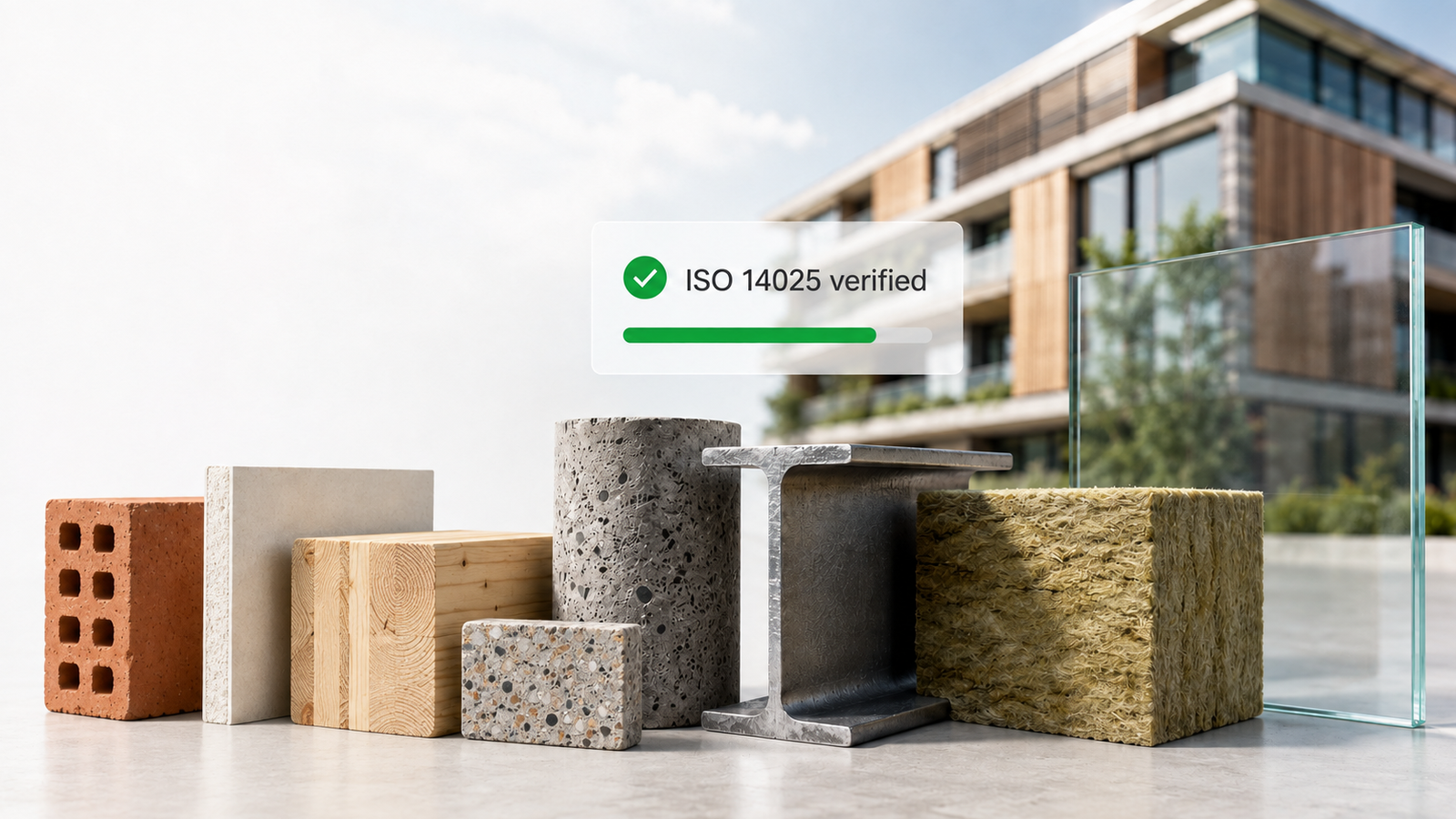
An Environmental Product Declaration (EPD) is a third-party verified report of a construction product’s environmental impact across its life cycle. In the building market it has moved from a marketing extra to a condition of sale. Architects, specifiers and public buyers increasingly ask for one before a product can be considered.
The right EPD for your goal, including tender-winning ones
Not every situation needs the same declaration. We build the right type for your purpose, and project-specific EPDs tailored to meet the exact requirements of a tender so your product stays compliant and wins the bid.
Third-party verified EPDs
Independently verified to ISO 14025 and EN 15804 and published with a recognised programme operator. The version accepted for public tenders, green-building credits and export markets.
Tender & project-specific EPDs
Built to the exact functional unit, Product Category Rule and indicators a specific tender or project demands, so your product meets every criterion and stays compliant.
Research EPDs
A full, standards-based EPD prepared without third-party verification. Ideal for internal benchmarking, early marketing, and getting ready before formal verification.
Private EPDs
For internal decision-making, eco-design and management reporting, kept confidential rather than published publicly.
White-label EPDs
Prepared for you to publish and share under your own brand, ready for distributors, group companies or your own product range.
Incubation EPDs
For new or early-stage products with less than 12 months of production data, built on available and scenario data with clear, documented assumptions.
More on incubationThe standards we work to
ISO 14025
Sets the framework for Type III environmental declarations, always third-party verified.
EN 15804+A2
The core Product Category Rule for construction products in Europe: which stages to model, which indicators to report, and how to present results so two products compare like for like.
ISO 21930
The international core rules standard for construction works, used widely across North America.
Every credible construction EPD sits on a Product Category Rule (PCR): the product-specific recipe that makes declarations comparable. We identify the correct PCR for your product before any modelling begins.
Our six-step EPD process
Scope & PCR selection
Define the product, functional unit and applicable PCR.
Data collection
Gather your bill of materials, energy and process data, under NDA.
Life cycle assessment
Model impacts to ISO 14040 and ISO 14044.
EPD drafting
Compile results into EN 15804+A2 or ISO 21930 format.
Third-party verification
An independent verifier reviews the LCA and EPD.
Publication
Register with a recognised programme operator.
Global need and national requirements
The new Construction Products Regulation entered into force in January 2025, with most provisions applying from 2026, including steps toward a Digital Product Passport.
RE2020 requires a whole-building life cycle assessment. INIES declarations (FDES, PEP ecopassport) replace penalised defaults. Since January 2025 the Ic Construction ceiling is 530 kg CO2e per m2 for houses and 650 for multifamily.
Buy Clean policies in California, Colorado, New York, Minnesota and Washington require EPDs for named materials. From January 2025 California demands facility-specific, verified EPDs, not industry averages.
GRIHA and IGBC reward EPDs, and exporters to the EU face the Carbon Border Adjustment Mechanism on steel, aluminium and cement.
Accepted where you sell
We match your product to the right PCR and programme operator for your target market, model the LCA on verifiable data, and manage verification and publication end to end. Verified declarations also earn credits in green-building schemes such as LEED v4, BREEAM, GRIHA and IGBC, so the result is a declaration accepted where you sell, not just technically correct.
EPD verification support and critical-review readiness
Already have a life cycle assessment or an EPD in progress, on your own or with another consultant, and facing a verifier’s critical review? We step in to get you across the line. We are well versed in the requirements of the major programme operators, including the International EPD System (EPD International), EPD Norge, UL Solutions and EPD Hub, so we know exactly what each verifier will expect.
Our support includes a scientific critical review of your LCA that is rigorous both academically and technically:
- Review of your LCA model, assumptions, data sources and modelling choices
- Checking compliance with ISO 14040/44, EN 15804 and the applicable Product Category Rule
- Verification of calculations, background data selection and results
- Resolving the verifier’s comments and preparing a clear, defensible response
- Getting the EPD document ready for smooth verification and publication
EPD questions we hear most
What is an EPD, and do I legally need one?+
An EPD is a third-party verified report of a construction product’s environmental impact across its life cycle, to ISO 14025 and EN 15804. It is rarely a legal requirement by itself, but architects, green-building schemes and public tenders increasingly demand one, and rules like France’s RE2020 and US Buy Clean effectively require verified EPDs for named materials. In practice, no EPD often means no bid.
Which standard and programme operator do I need?+
It depends on your market. EN 15804+A2 with ISO 14025 covers Europe; ISO 21930 is used across North America. We match your product to the correct PCR and a recognised programme operator, such as EPD International, EPD Norge, UL Solutions or EPD Hub, before any modelling begins.
How long does an EPD take, and what does it cost?+
Most EPDs take 8 to 12 weeks once your data is ready. Cost depends on product complexity, data readiness and verification fees; we scope and quote clearly before any work starts, and reusing one LCA model across a product family lowers the cost of each additional declaration.
Can you help if my EPD or LCA is already in progress?+
Yes. If you are mid-project, or stuck on a verifier’s critical-review comments, we provide verification support and a scientific critical review of your LCA, and take the declaration through to publication.
Selling into construction?
Get a verified EPD that wins specifications, or expert help to finish one you have already started.
Request an EPD quote